Reset, Repeat, Reassess: Tracing a Tripping RCD Without Compromising Safety
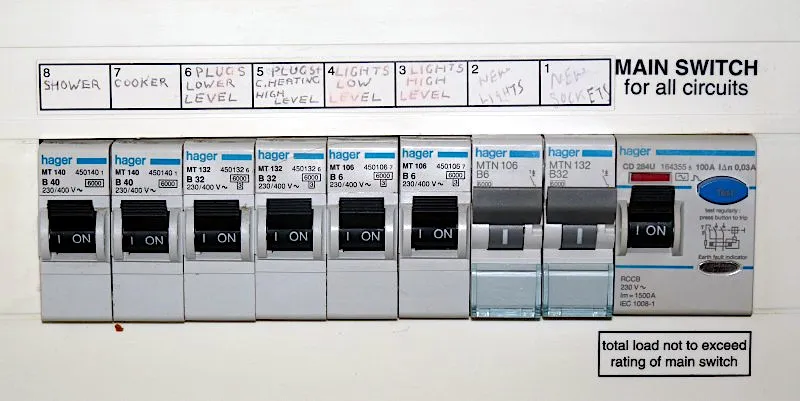
Photo: Pfnicholls, CC BY-SA 4.0, via Wikimedia Commons
A residual current device that will not stay up can feel like an inconvenience at best and a mystery at worst. In a UK consumer unit, however, the RCD is not there to be convenient. It is there to detect a dangerous imbalance in the electrical supply and cut power before that imbalance becomes a shock or a fire. When it trips repeatedly, the correct response is not to hold the switch up and carry on. It is to treat the device as a source of information and to investigate in a controlled way.
First, identify what has actually tripped
Consumer units vary. Some have a single RCD protecting a group of circuits; others use individual RCBOs, where each circuit has its own combined protection. Before touching anything, look at the unit and note which switch has moved. If one RCBO has tripped, the search is confined to that circuit. If a wider RCD has tripped, several circuits may be affected, and the fault could sit on any of them.
It also helps to record the circumstances. Was it raining? Had an appliance just started? Was a washing machine, dishwasher or outdoor light in use? Did the trip occur at night when little was running? A simple note on a phone is enough, but the pattern often narrows the field faster than any amount of repeated resetting.
The first ten minutes: isolate, unplug, record
Begin by switching off and unplugging appliances on the affected circuits. Unplugging matters more than switching off at the socket, because some faults remain present on the supply side of the switch. Remove phone chargers, extension leads, kitchen appliances, garden equipment and anything with a heating element. If water is visibly present near a socket or appliance, do not touch the area; isolate the supply at the consumer unit if it is safe to do so and seek qualified help.
Once the likely loads are disconnected, reset the device once. If it holds, do not assume the problem has gone away. Reintroduce appliances one at a time, allowing each to run for a few minutes before adding the next. This is not a race. The aim is to find the point at which the device trips again, not to restore every appliance as quickly as possible.
Nuisance tripping versus a genuine fault
The phrase nuisance tripping is often used too loosely. A genuine nuisance trip may come from the cumulative leakage of many electronic devices, from moisture in an outdoor socket, or from an ageing component within the installation. A genuine fault may be an appliance heating element that has failed, a damaged cable, water ingress, or degraded insulation. The two require different responses, and the distinction is not always obvious from the switch alone.
Patterns are useful. A trip that follows rain may point to an outdoor circuit or a damp wall. A trip that occurs when the washing machine reaches a particular part of its cycle suggests the appliance. A trip that happens after several devices are connected may indicate cumulative leakage rather than a single failed item. A trip that occurs with everything unplugged is a strong signal to stop and call an electrician.
A room-by-room method that respects the device
Work systematically rather than randomly. Start with the room where the trip occurred, then move through adjoining rooms on the same circuit. In a kitchen, check the obvious heat-producing appliances first: kettle, toaster, washing machine, dishwasher, tumble dryer and any under-counter heater. In a living room, look at extension leads, chargers and entertainment equipment. Do not forget outside: garden lights, pond pumps and outdoor sockets are common sources of moisture-related tripping.
If the device holds with all appliances disconnected, reintroduce them one by one. If it trips as soon as a particular appliance is connected, even before the appliance is switched on, treat that appliance as suspect and leave it disconnected. If it trips only when an appliance is running, allow the appliance to reach its normal operating condition before deciding. Some faults appear only when a motor starts or an element heats.
When repeated resetting becomes a risk
There is a point at which resetting stops being diagnostic and starts being unsafe. Do not keep resetting if the device trips immediately with all appliances unplugged, if there is a burning smell, scorch marks, heat at a plug or socket, buzzing, or visible water ingress. Do not tape the switch up, bypass the RCD, or replace it with a higher-rated device to stop it tripping. These measures remove the protection that is doing its job.
Also stop if the trip is accompanied by any sign of damage to the consumer unit itself. A warm or discoloured switch, a loose cover or a persistent hum are reasons to isolate the supply and call a qualified electrician. The same applies if the RCD test button does not operate correctly.
What to tell the electrician
A clear account saves time. Note which device tripped, how often, at what times, and under what conditions. List what you unplugged and whether the device held afterwards. Mention any recent work, new appliances, leaks, storms or outdoor alterations. If you rent, report the fault to the landlord or letting agent in writing and keep a record. If you manage a holiday let or empty property, treat a tripping RCD as a maintenance priority rather than something to be reset between guests.
The RCD is a safety device with a narrow brief: to disconnect when something is wrong. A homeowner's job is not to defeat it, but to give it less to complain about and to know when the next move belongs to a qualified electrician.